
How to Build a $10K/Month One-Person AI Agency Using GoHighLevel
Learn how to build a $10,000/month one-person AI marketing agency using GoHighLevel. Explore real agency case studies, profitable services, automation systems, and a practical client acquisition strategy.

Imagine running a marketing agency that generates $10,000 every month without hiring a single full-time employee.
No office, no payroll, and no team of designers, developers, or marketing assistants.
Just you, a laptop, and a collection of AI-powered systems handling much of the repetitive work.
This isn’t just a theoretical business model. There are already agency owners using GoHighLevel, automation, and productized services to build surprisingly lean businesses.
The business model is simple: find businesses with problems you can solve, create a repeatable solution, and charge a monthly fee to manage it.
For example, 10 clients paying $1,000 per month generate $10,000 in monthly recurring revenue.
Let’s look at how you can build this business, what you should sell, and some real examples of people already doing it.
1. Why AI Has Changed the Agency Business
Traditionally, growing an agency meant hiring more people.
A new client needed a website designer, copywriter, social media manager, automation specialist, and account manager.
The more clients you acquired, the more people you needed.
AI changes how much of that work needs to be done manually.
Today, you can use AI and automation to:
- Build websites and landing pages.
- Generate and schedule marketing content.
- Respond to incoming customer inquiries.
- Follow up with leads automatically.
- Book appointments and send reminders.
- Manage customer relationships through a CRM.
- Request reviews and prepare responses.
- Generate reports and identify opportunities.
Instead of hiring someone for every repetitive responsibility, you can build systems that handle much of the execution.
You still need to make decisions, manage clients, check quality, and acquire customers. But you don’t necessarily need a traditional agency team to deliver valuable services.
2. The $10,000/Month Business Model
You don’t need hundreds of customers.
Consider these two models:
| Clients | Monthly Fee | Revenue |
|---|---|---|
| 10 | $1,000 | $10,000 |
| 5 | $2,000 | $10,000 |
The second model requires fewer client relationships, but you must deliver enough value to justify the higher price.
Let’s use gyms as an example.
Instead of telling gym owners that you sell AI automation, offer them a complete system for generating and converting membership inquiries.
Your offer: Gym Growth and Automation System
- Professional website and membership landing pages.
- Lead capture forms connected to a CRM.
- AI-powered inquiry handling.
- Automatic follow-ups for potential members.
- Trial-session booking and reminders.
- Review collection and management.
- Reactivation campaigns for old leads.
- Monthly performance reporting.

The gym owner isn’t buying AI.
They’re buying a better process for turning potential members into paying customers.
That’s the difference between selling technology and selling a business outcome.
3. Real Examples of Lean Agencies
There are some interesting real-world examples worth studying. These aren’t earnings guarantees, but they show how focused offers, automation, and standardized delivery can create profitable businesses.
Example 1: Quinn Nolan — $25,000+ MRR With No Employees
Quinn Nolan’s agency case study describes a solo agency owner generating more than $25,000 in monthly recurring revenue, with no employees and reported profit margins of 85%.
His approach is particularly interesting:
- Focused exclusively on real estate investors.
- Sold Facebook advertising and GoHighLevel automation.
- Created a repeatable productized service.
- Offered a DIY software option alongside managed services.
- Used templates and automation to reduce delivery work.
The case study also describes a client who spent $9,200 on advertising and generated $55,000 in property closings over seven months.
The lesson: You don’t need to offer 20 different services. One well-defined offer for one industry can be enough to build a substantial business.
Note: These figures are reported in the UpHex-hosted case study, not independently audited financial statements.
Example 2: Russ Ward — Building Recurring Revenue With HighLevel
HighLevel’s case study of Russ Ward describes how he built recurring revenue around HighLevel subscriptions, automation, and AI-powered lead qualification.
Some reported numbers:
- Approximately $12,000 in monthly recurring revenue after acquiring around 120 new account subscribers.
- 37 active paying customers across different offers.
- One full-time team member handling fulfillment.
- A reported $22,115 revenue month in August 2024.
His model included AI receptionists, lead reactivation, snapshots, and software subscriptions.
The lesson: Recurring revenue and reusable systems can be more valuable than constantly selling one-off projects.
This isn’t a completely solo operation, but it demonstrates how a very small fulfillment setup can serve multiple customers.
Example 3: Rex Marketing & CX — $10,000/Month With Zero Employees
In an interview published by Starter Story, Ryan Ward explained how he and his co-founder built Rex Marketing & CX to approximately $10,000 in monthly revenue within its first year.
The interesting part is that they:
- Started the agency as a side project.
- Maintained their full-time jobs while building it.
- Used AI, automation, and outsourcing.
- Acquired customers through existing relationships and referrals.
- Expanded into SEO, growth marketing, and no-code development.
Starter Story reported two founders and zero employees.
The lesson: You don’t need a large team or significant initial investment to start generating agency revenue.
These examples demonstrate three useful approaches: a focused solo agency, recurring software and automation revenue, and a lean service agency.
4. Build Your AI Team Inside GoHighLevel
Now, how would you actually deliver these services?
GoHighLevel can serve as the operational foundation for your agency.
Think of its different capabilities as members of your virtual team.
| Your AI Team | What It Handles |
|---|---|
| Strategist | Offer development and marketing ideas |
| Website builder | Landing pages and websites |
| Marketing assistant | Content creation and scheduling |
| AI receptionist | Customer inquiries and lead qualification |
| Review manager | Review requests and response drafts |
| Operations manager | CRM, reminders and follow-up workflows |
The real advantage comes from connecting everything.
For example, when someone submits a gym membership inquiry:
- Their information enters the CRM.
- An automated acknowledgment is sent.
- The AI assistant answers relevant questions.
- The lead is encouraged to book a trial.
- Appointment reminders are sent.
- The gym receives the lead information.
- Unconverted leads enter an appropriate follow-up sequence.
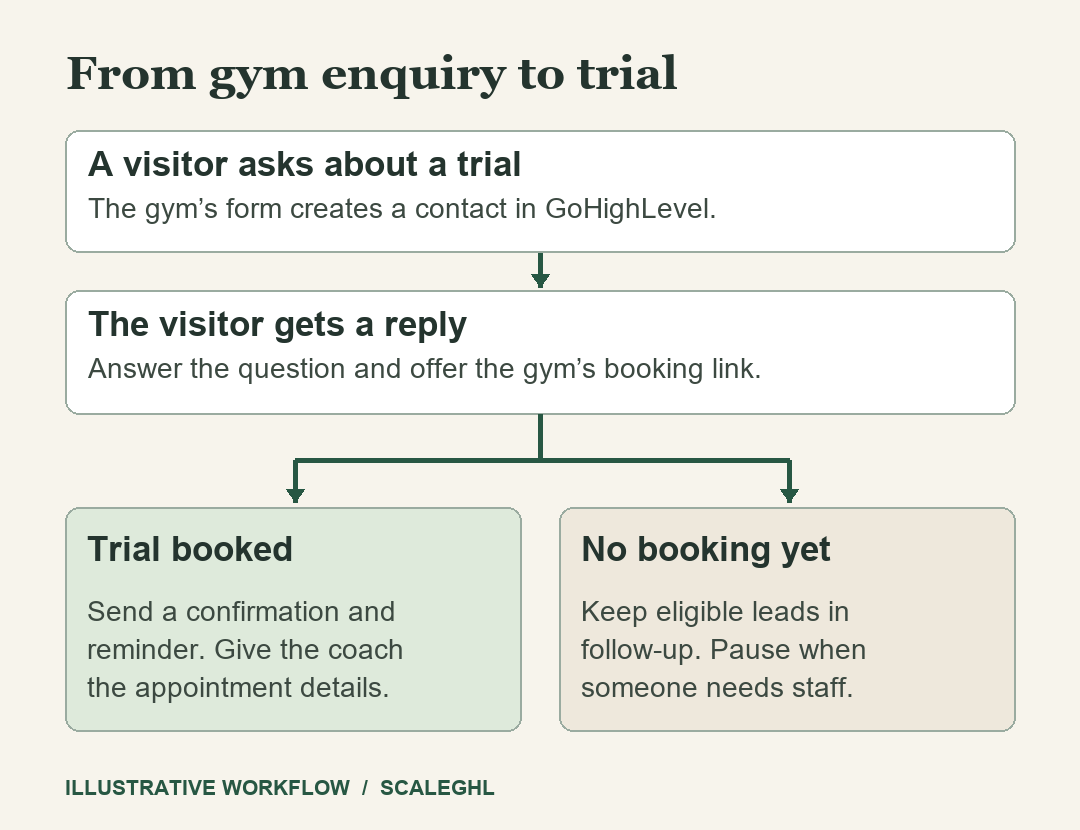
You build this system once, test it, and customize it for the next gym.
Use GoHighLevel snapshots to reuse websites, pipelines, workflows, and other account configurations instead of rebuilding everything from scratch.
AI won’t eliminate quality control, but it can remove a considerable amount of repetitive work.
5. How to Get Your First 10 Clients
This is where the actual business begins.
You don’t need to spend thousands of dollars on advertising to get started.
Start by choosing one industry and finding 100 businesses.
For example, if you choose gyms, look for businesses with:
- Outdated websites.
- No simple trial booking process.
- Unanswered customer inquiries.
- Poor lead follow-up.
- Unmanaged reviews.
Don’t send them a generic message about AI.
Find one specific problem and suggest a solution.
Example outreach message:
Subject: Quick idea for [Gym Name]
Hi,
I was checking out your gym and noticed that potential members don’t have a particularly easy way to book a trial session.
I had an idea for a simple system that could capture inquiries, answer common questions, and automatically follow up with people who haven’t booked.
I could put together a quick demonstration using your gym so you can see what I mean.
Would you be interested in taking a look?
Once someone responds, build a small demonstration.
Show them the website, inquiry form, automated follow-up, and booking process.
If they like it, present your monthly package.
Your initial goal isn’t to close 10 customers immediately. It’s to get one customer, deliver a good result, and use that experience to improve your offer.
6. How to Operate the Agency Without Burning Out
A one-person agency can quickly become another full-time job if you accept unlimited custom work.
You need boundaries and standardized delivery.
A simple operating model looks like this:
- Monday: Check client performance and automation issues.
- Tuesday: Review content and marketing campaigns.
- Wednesday: Handle client communication and improvements.
- Thursday: Work on sales and prospecting.
- Friday: Review reporting, renewals, and opportunities.
Automate routine reporting and notifications, but personally review anything that affects customer experience or business results.
Also, calculate your costs properly. Your $10,000 revenue target isn’t $10,000 in personal profit. Software, AI usage, phone and SMS charges, advertising, taxes, and other expenses all matter.
7. Your Roadmap to $10K/Month
Here’s a practical progression:
| Stage | Target | Main Priority |
|---|---|---|
| First client | $1,000 MRR | Validate your offer |
| Three clients | $3,000 MRR | Standardize delivery |
| Five clients | $5,000 MRR | Improve acquisition |
| Seven clients | $7,000 MRR | Reduce manual work |
| Ten clients | $10,000 MRR | Retention and optimization |
These are milestones, not guaranteed timelines.
Don’t hire people simply because you have more customers. First, see how much of the work can be standardized and automated. Hire or outsource when the remaining work genuinely requires it.
Frequently Asked Questions
Can one person run a $10,000/month AI agency?
Yes. A solo founder can target $10,000 in monthly revenue through a focused service offering, recurring contracts, and automated delivery. Real examples include Quinn Nolan, whose UpHex-hosted case study reports more than $25,000 in MRR while operating without employees.
What is the best service to sell through GoHighLevel?
Lead management, automated follow-ups, appointment booking, AI receptionists, CRM implementation, and review management are practical starting points. Choose services based on the problems your target industry actually has.
How many clients do you need to make $10,000?
You need 10 clients paying $1,000 monthly, five paying $2,000, or another combination that reaches your revenue target.
Do you need employees to start an AI agency?
No. You can start with one person and use automation, reusable templates, and AI tools to handle repetitive delivery tasks. You may eventually need specialist support as your client base grows.
Final Thoughts
The opportunity isn’t that AI can write emails or generate websites.
It’s that one person can now deliver a combination of services that previously required several specialists.
But the businesses that succeed won’t necessarily be those using the most AI tools.
They’ll be the ones that understand a particular industry’s problems, build a solution around those problems, and consistently deliver value.
Start with one niche, one offer, and one customer.
Build a system that works, document it, and repeat it.
That’s how you turn a collection of AI tools into an actual $10,000/month agency.